
Museum of the Battle of Warsaw 1920 in Ossów – an interactive historical space with immersive technologies
Author: Łukasz Kornafel, “AVIntegracje”
Images: ESS Audio
Historical museums, especially those focused on the military, fulfill numerous functions. They enable exploration of the past and facilitate understanding of complex historical processes, battlefields, and changes in national borders. They help build national and local identity, encourage inquiry, contribute to the development of tourism, enhance education, and ultimately, play a key role in preserving and conserving the material heritage of the past.
However, to effectively tell the story of the past, especially about such a difficult and complex topic as the military, appropriate technical resources are necessary. That’s why museum creators are so keen to use modern communication tools that increase audience engagement, attract attention, allow for personalized visits, a tailored pace, and even interaction with exhibits and sites. A prime example of such a modern museum is the Museum of the Battle of Warsaw 1920 in Ossów, which opened on August 16, 2025, precisely on Polish Armed Forces Day. It’s a place where every corner is filled with modern AV solutions, where the words multimedia and immersion are uttered in every possible way. It’s also an exhibition that skillfully combines history with modern means to tell its story.

The Museum of the Battle of Warsaw 1920 is located at the very site where the dramatic Battle of Ossów took place over 100 years ago, one of the key moments of the Miracle on the Vistula, which had a fundamental impact on Poland’s preservation of independence.
The architectural competition, organized in 2017, was won by the “DiM’84 i Miasto” studio. Construction of the facility was announced in 2018, and initial construction work began shortly thereafter. The Museum of the Battle of Warsaw 1920 in Ossów is situated on a 17-meter-high hill, with a total usable area of 4,800 m². The 1,000 m² exhibition spans two floors, which also house meeting rooms, educational spaces, offices, and a cinema that can be used as an auditorium.
The institution’s building, which is characterized by a simple, regular shape, is accessed via the 500-meter-long Victory Avenue, while the eastern and western ends of the site are marked by two 70-meter-high masts.
Visitors to the museum can also enjoy the observation deck and admire regularly held reenactments. The new amphitheater, located on the hillside, seats 2,760. The exhibition was designed to recount the past and showcase the significance of the Battle of Warsaw in an engaging, modern, and immersive way. The exhibition combines unique exhibits: weapons, uniforms, and documents from 1920, faithful replicas, memorabilia related to the heroes of one of the most important victories in Polish history, interactive stations, large-format projections, immersive sound, and multimedia solutions that transport visitors to the realities of 1920.
Although construction work related to the creation of the Museum of the Battle of Warsaw 1920 took a considerable amount of time, the contract for the AV installation in the facility was signed while construction was well underway. The task of providing the installation and commissioning of all audiovisual equipment was entrusted to Group AV, which had only a few months to complete the entire project. In this relatively short timeframe, considering the scale of the project, the integrator also had to make adjustments to some of the prepared specifications and create some connections from scratch.
Group AV’s scope included: comprehensive project preparation and execution of the exhibition, development of the set design concept and production of the structures, installation of multimedia, sound systems, projection mapping, installation of large-format LED screens, design and production of large-format graphics, implementation of interactive stations, including a virtual shooting range, design, production, and installation of museum display cases, design and implementation of immersive solutions, and comprehensive furnishing of the multi-purpose hall (cinema, events, performances, concerts, etc.). One of the greatest challenges for Group AV specialists was coordinating all the work and collaborating with multiple teams, which began work on the facility many months earlier.
The reinforced concrete structure of the building itself also presented some challenges, making cable management difficult, as did the size of the facility and its extensive footprint. Many cables were installed during the construction phase. For example, three large LED screens were installed in the lobby. Both power and signal cables exit behind the displays and either run to the other side of the wall, where they are covered by scenographic elements, or they run directly above the auditorium ceiling and reach their respective locations. In many areas of the facility, the integrator installed not only twisted-pair cables but also fiber optic cables, which serve two functions. First, they connect network distribution points, acting as a bridge between two server rooms assigned to each part of the building; second, they connect intermediary cabinets. These are also used to transmit images to the LED screens.
The entire museum space has been physically and functionally divided into three sections. The facility houses the exhibition, the auditorium, which combines meeting space and cinema functions, and the entrance hall, which has also been designed and equipped to accommodate conferences. It also includes additional rooms, such as bathrooms, a shop, corridors, and a complete backstage area.

A Stately Entrance Hall Full of Challenges
Upon entering the museum, visitors are greeted by a stately hall. Equipping it with appropriate AV solutions was a considerable challenge, especially when it came to sound. The space is enormous, with parallel concrete walls, a high ceiling, a stone floor, and a lack of finishing touches that could help absorb sound and reduce reverberation time. Only the aforementioned three large LED screens offer limited assistance in reducing reverberation. Therefore, the decision was made to install JBL CBT 70J-1 speakers, which allow for very precise beam control, eliminating unnecessary reflections that degrade sound quality.
The CBT 1000 model was installed at the main screen. The column speakers in the main hall are supported by Control SB2210 subwoofers. Additionally, JBL AC16 speakers were installed above the entrance and below the screens. Their purpose is to provide a spacious feel, playing multi-channel, immersive music, specially composed for this space. For events held here, they offer maximum clarity, speech intelligibility, and listening comfort thanks to the proximity of the sound sources. To easily accommodate conferences, the walls below the screens are equipped with audio and video connections, and presenters have access to a set of Sound Devices wireless microphones, including handheld microphones with Austrian Audio microphone heads and bodypacks.
The choice of Sound Devices solutions was primarily driven by the fact that the entire structure is constructed using a significant amount of steel and concrete, which naturally impacts transmission. Furthermore, there are significant distances between the microphones, antennas, and the control room, where all signals converge. By using microphones that dynamically adjust their resolution and transmit sound digitally, we avoid any interference or interruptions in signal transmission. A main Samsung P2.5 LED screen and two side P2.0 screens were installed in the entrance hall.
The image presented on the central display has a UHD resolution of 3840×2600 pixels, while the right and left screens have a 3K resolution of 2880×1620 pixels.
Each of the LED screens located in the entrance hall can display a signal from virtually any location in the building. To provide users with this capability, AMX NMX-DEC-N2622S and NMX-ENC-N2612S AV-overIP transmitters and NMX-ENC-N2615-WP wall adapters from the same manufacturer were installed in the facility. These can be used not only to connect a laptop or other AV source, but also to feed audio into the network and receive necessary signals, such as recording or transmitting them outside the building. All this is possible thanks to the Dante network that spans the entire building.
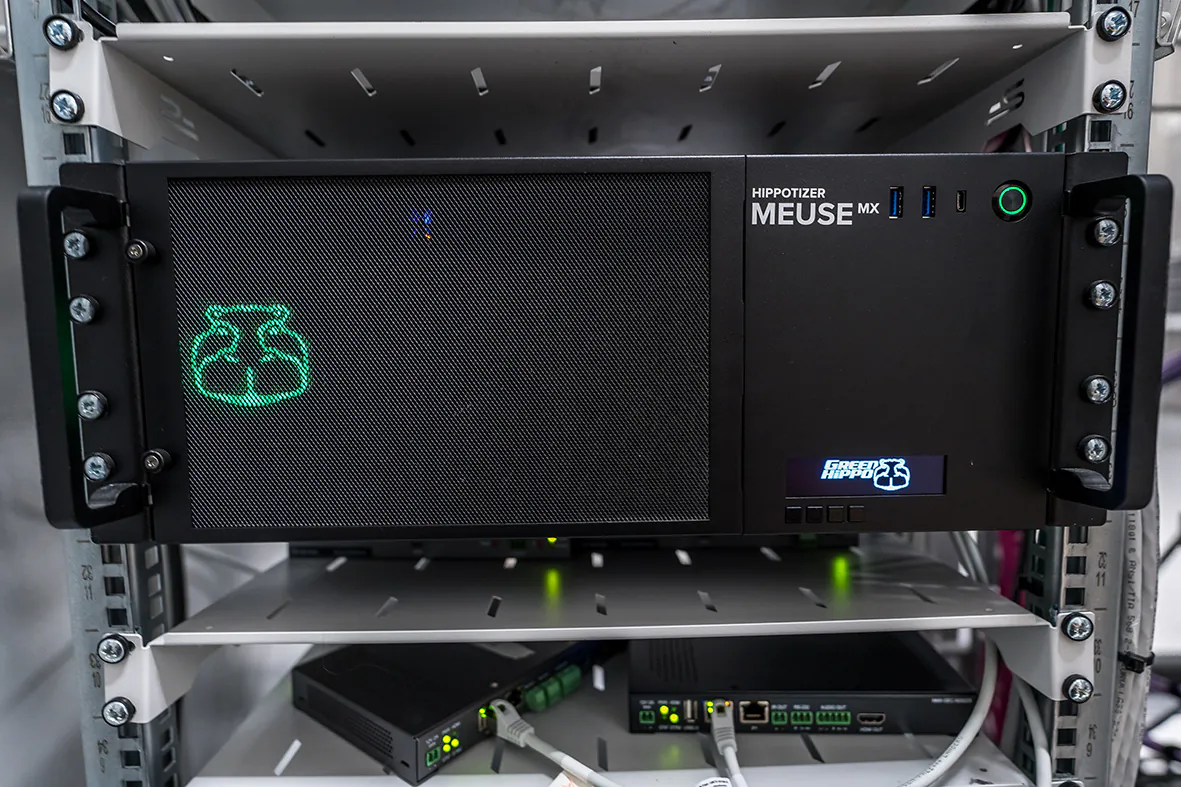
The graphics prepared for the lobby are played back using a Green Hippo Hippotizer Meuse MX Media Server. Audio is played back using Flux software, which contains all the settings that facilitate audio management in this acoustically challenging space.
Read the full article on AVIntegracje >>
This article was originally published in Polish by AVintegracje and has been translated into English for this website. Every effort has been made to ensure the accuracy of the translation.